NASA's Roman Space Telescope: The Mission to Map the Universe
Rather than staring at single objects, the Nancy Grace Roman Space Telescope is building a colossal, repeatedly observed map of the universe. It’s not hunting for one dramatic picture - it’s hunting for the universe's biggest answers.
Also available in: Vietnamese
On this page
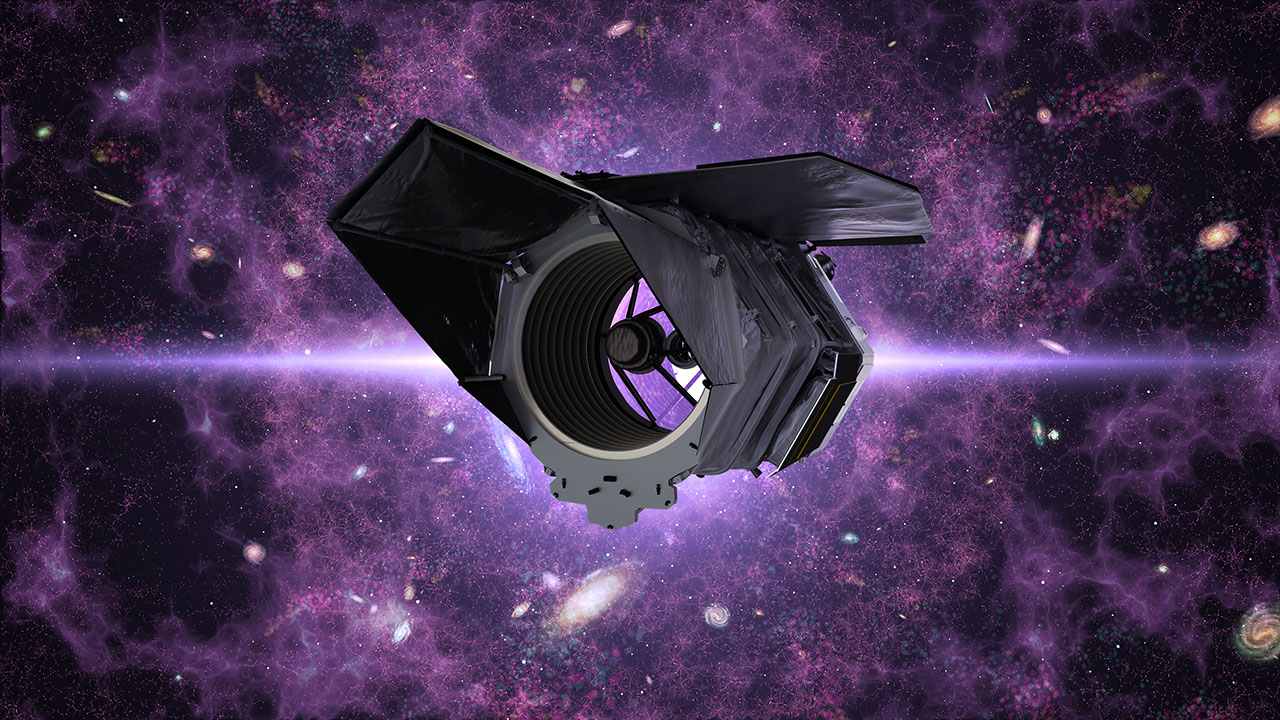
Illustration of the Roman Space Telescope, from NASA's Roman mission page. Credit: NASA
NASA recently announced the deployment of a new space telescope named Nancy Grace Roman, which is expected to provide powerful new perspectives for astronomy and humanity's exploration of the universe.
Most space telescopes work like a spotlight: point them at one thing and look hard. NASA's Nancy Grace Roman Space Telescope is built more like a surveyor's camera. It launched on a SpaceX Falcon Heavy from Kennedy Space Center on August 30, 2026, at 7:26 a.m. EDT. [1] NASA says the mission was "delivered ahead of schedule and on budget", and that its first science images are expected by early 2027. [2]
Instead of doing just one thing, the Roman Space Telescope will carry out several massive research projects at the same time, while also testing new technologies in space. This post explores how it will spend its five years, what it has already accomplished in orbit, and what we still do not know.
Where Roman is right now
The trip to its final orbit takes about three months and covers about one million miles, ending at a point called L2. [2] NASA wrote on September 15 that Roman was still on its journey to L2 and that the mission remained on track for first science images by early 2027. [3] The same post reported that NASA had activated Roman's primary instrument and begun checking out the Coronagraph. [3]
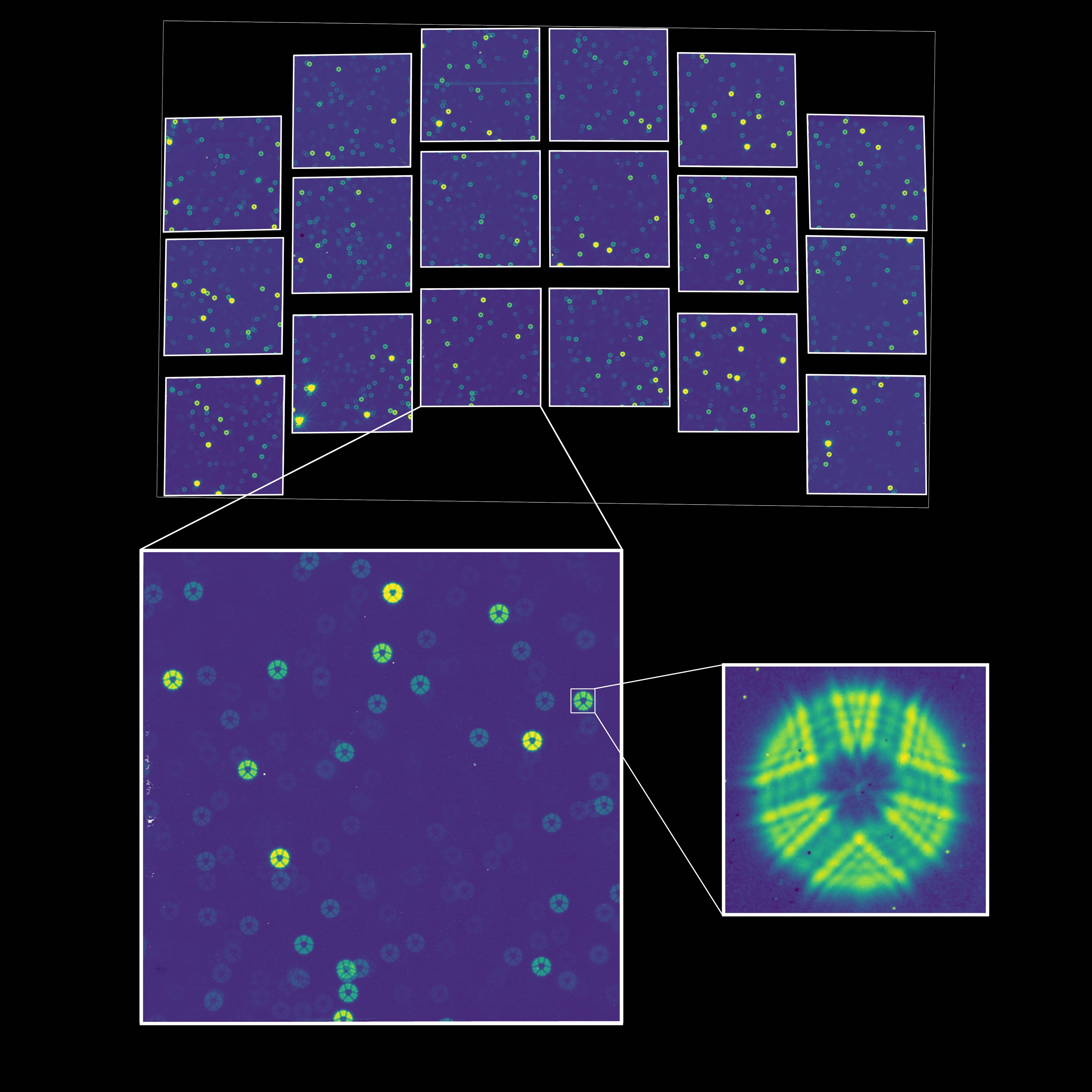
Test image from Roman's Wide Field Instrument, shown in NASA's September 15 update. Credit: NASA
On September 22, the Coronagraph took its first observation, of a faint star in the Large Magellanic Cloud, a neighboring galaxy. [4] NASA says that observation confirms the instrument can make a focused image, and calls it a very limited test that starts a methodical series of harder tasks. [4] On September 27 the Coronagraph looked at a new spot in the same galaxy, where many stars were expected in a single image, and they appeared. [4]
Until now, we still don’t know whether Roman has arrived at L2 or when its surveys will begin, as recent NASA updates have not mentioned this. [4]
The same sharp lens, a much bigger window
Roman's main mirror is 2.4 meters across, the same size as Hubble's. [5] Its Wide Field Instrument takes images as crisp as Hubble's over a field of view at least 100 times larger, 0.28 square degrees. [5] Think of Hubble as showing you one street corner in fine detail. Roman shows you the whole neighborhood at the same detail.

Wide Field Instrument: exploded view. Credit: Benjamin Cromey / Wikimedia Commons, CC BY 4.0 (https://creativecommons.org/licenses/by/4.0)
One survey, three zoom levels
One of Roman's main programs is the High-Latitude Wide-Area Survey, which has three tiers: Medium, Deep and Wide. [6] Picture a map you can zoom into: a road atlas, a city map and a street view.
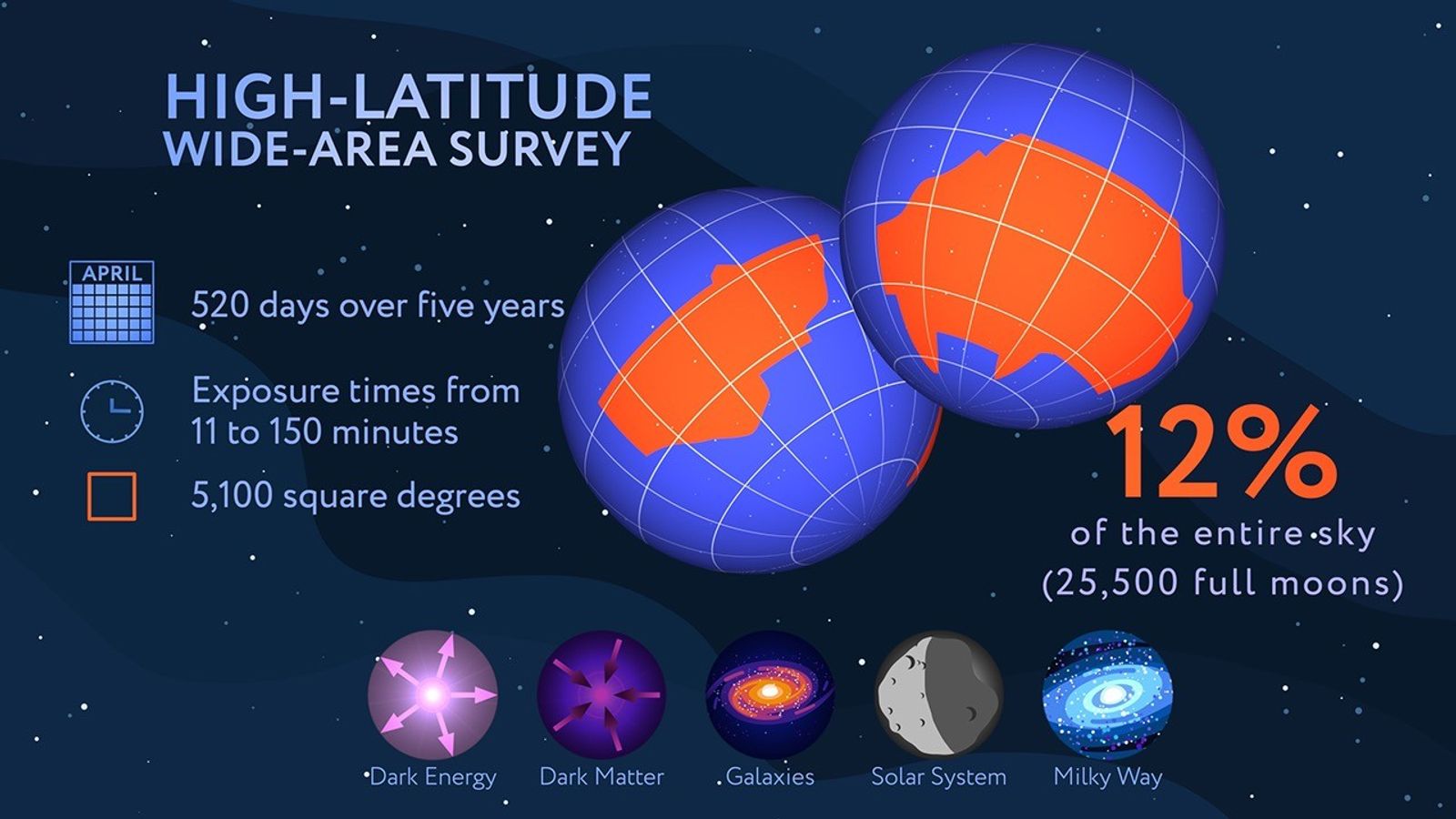
NASA infographic for the High-Latitude Wide-Area Survey, from the survey's technical page. Credit: NASA
The Wide Tier is the road atlas. It adds 2,700 square degrees imaged in one near-infrared filter, with the same exposure times as the Medium Tier, bringing the whole survey to over 5,000 square degrees. [6]
The Medium Tier is the city map: 2,400 square degrees imaged in three near-infrared filters, with both images and spectra. [6]
The Deep Tier is the street view. It covers only 19.2 square degrees, including two deep fields shared with Rubin Observatory, but its imaging goes about 1.2 magnitudes deeper, meaning it picks up fainter objects, and its spectroscopy exposures are eight times longer. [6] Inside it, a 5-square-degree ultra-deep patch goes 1.7 magnitudes deeper than the Medium Tier, and is meant for calibrating weak lensing shape measurements. [6]
The goal of all this is to probe the origin of cosmic acceleration, using weak gravitational lensing and the way galaxies cluster, including patterns called baryon acoustic oscillations. [7] NASA allocates about 17 months to the survey, with at least half of the Deep Tier observed early in the mission and most of the Wide Tier late. [6]
Catching exploding stars
A second program, the High-Latitude Time-Domain Survey, watches the same patches of sky again and again to catch things that change. It uses Type Ia supernovae, exploding stars, to measure how the universe has expanded. [8] It targets supernovae at a wide range of distances, from a redshift of about 0.5 to more than 2.5. [9]
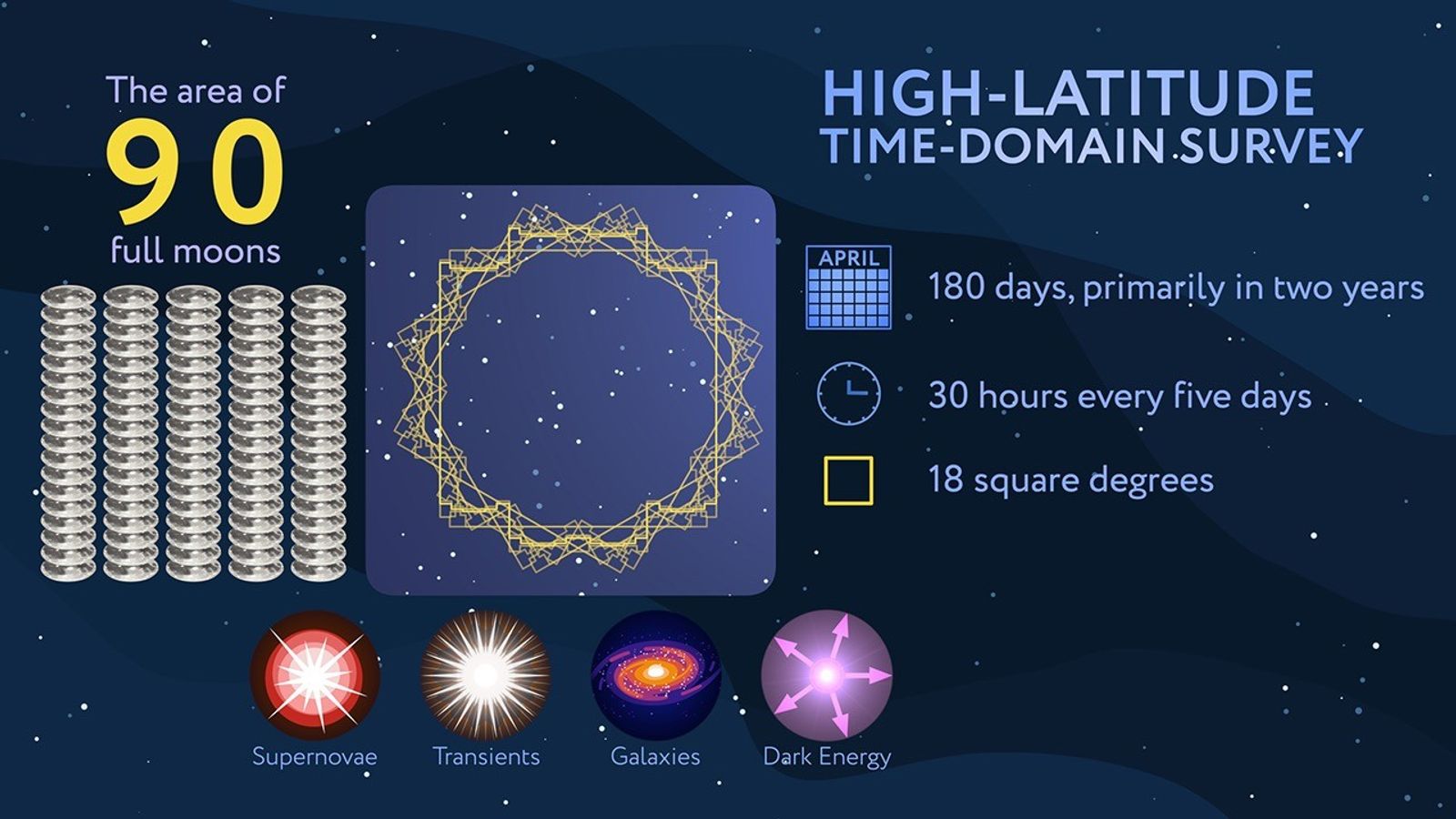
NASA infographic for the High-Latitude Time-Domain Survey, from the wide-area survey's technical page. Credit: NASA
The core of the survey lasts about two years in the middle of the prime mission. [8] STScI's documentation, updated in August 2026 to match the current flight plan, says the survey's northern and southern fields are each visited every 5 days. [9] In the southern field's imaging tiers, only the bluest filter is repeated every time, while the other four filters repeat every 10 days, in alternating pairs, so colour information arrives every 5 days. [9] NASA Goddard's page describes the same rhythm as an interlaced 10-day cadence, with filter subsets every 5 days. [8] The whole survey is allocated about six months of observing time. [8]
So how many supernovae will it find? The NASA pages I read give no official count. A simulation study, which is not a promise, found about 10,000 Roman Type Ia supernovae in its simulated sample, combined with 4,400 from a separate survey called LSST. [10] Its simulated dark-energy score, called a figure of merit, beat NASA's mission requirement of 326, though the authors note that some systematic errors were not included. [10]
Planets from bent space
Roman's third big program, the Galactic Bulge Time-Domain Survey, stares at the crowded center of the Milky Way. NASA expects it to find more than a thousand wide-orbit planets and more than 100,000 transiting planets, across six seasons spread over the five-year mission. [11] It complements the Kepler and TESS missions, and it can find free-floating planets that orbit no star. [11]
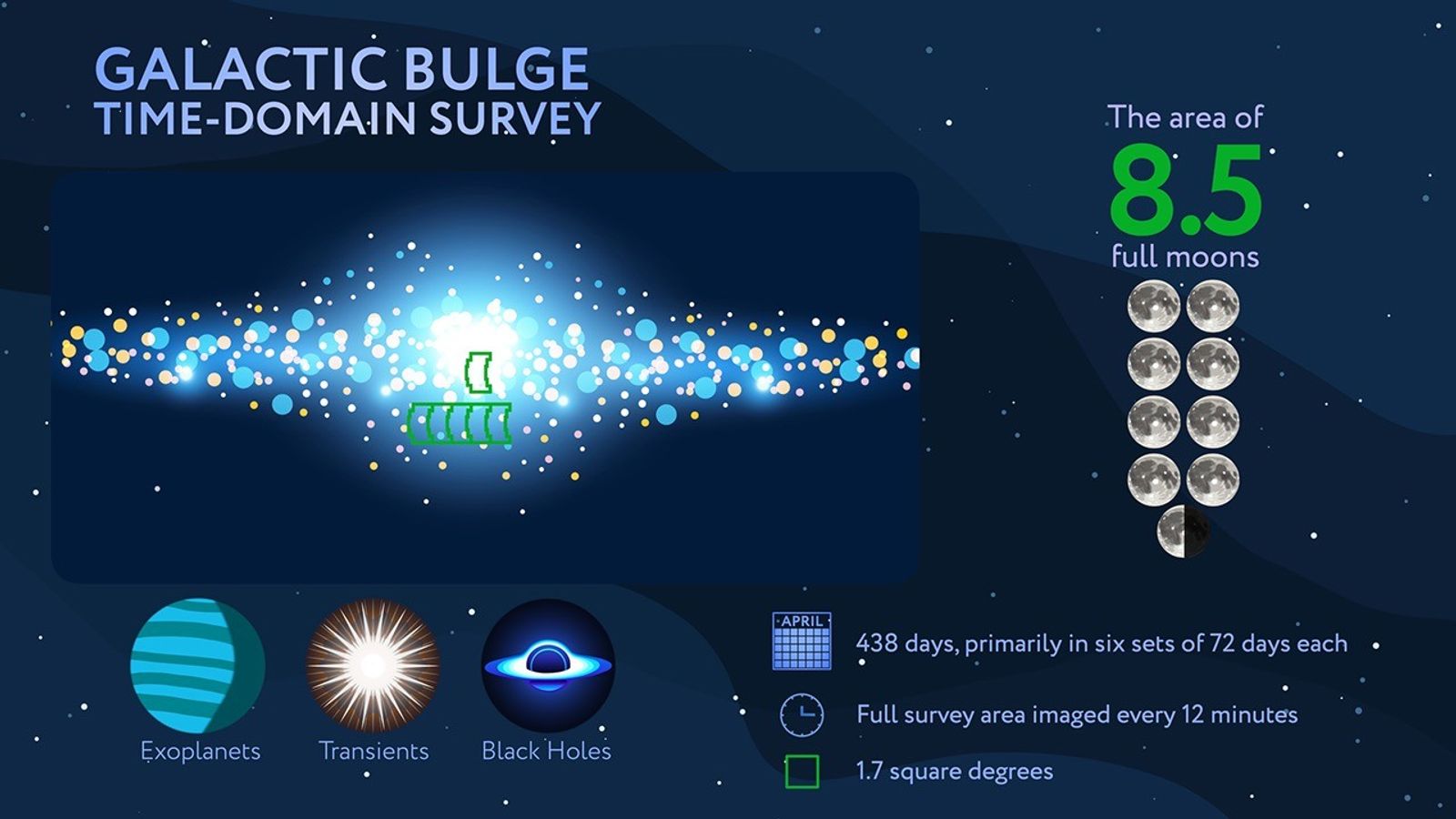
NASA infographic for the Galactic Bulge Time-Domain Survey, from the wide-area survey's technical page. Credit: NASA
The method is called microlensing. NASA explains that light normally travels in a straight line, but near something massive, like a star, space-time bends and light follows the curve. [12] Think of a star passing in front of a more distant one as a natural magnifying glass. By observing through this "natural magnifying glass", Roman can discover dark, Earth-sized worlds or solitary free-floating planets drifting in space which are targets that are simply too faint for any optical telescope to see directly.
NASA says microlensing is best suited to finding worlds from the habitable zone of their star and farther out. [12] The survey, it says, will help find analogs to every planet in our solar system except Mercury, and could detect planets with the mass of Earth and even smaller. [12]
STScI's documentation describes two kinds of seasons: high-cadence seasons with a 12-minute cadence, meant to capture events from small, long-period planets and free-floating planets, and low-cadence seasons with a five-day cadence. [13] The survey covers 1.7 square degrees of the Milky Way's bulge, in six fields. [13] I could not find an official number for how many stars it will watch.
A rehearsal for finding Earth-like worlds
Roman also carries a test: the Coronagraph, which NASA calls a technology demonstration. [5] A coronagraph blocks a star's glare so that much fainter things beside it, such as planets and dusty disks, can be seen. [14]
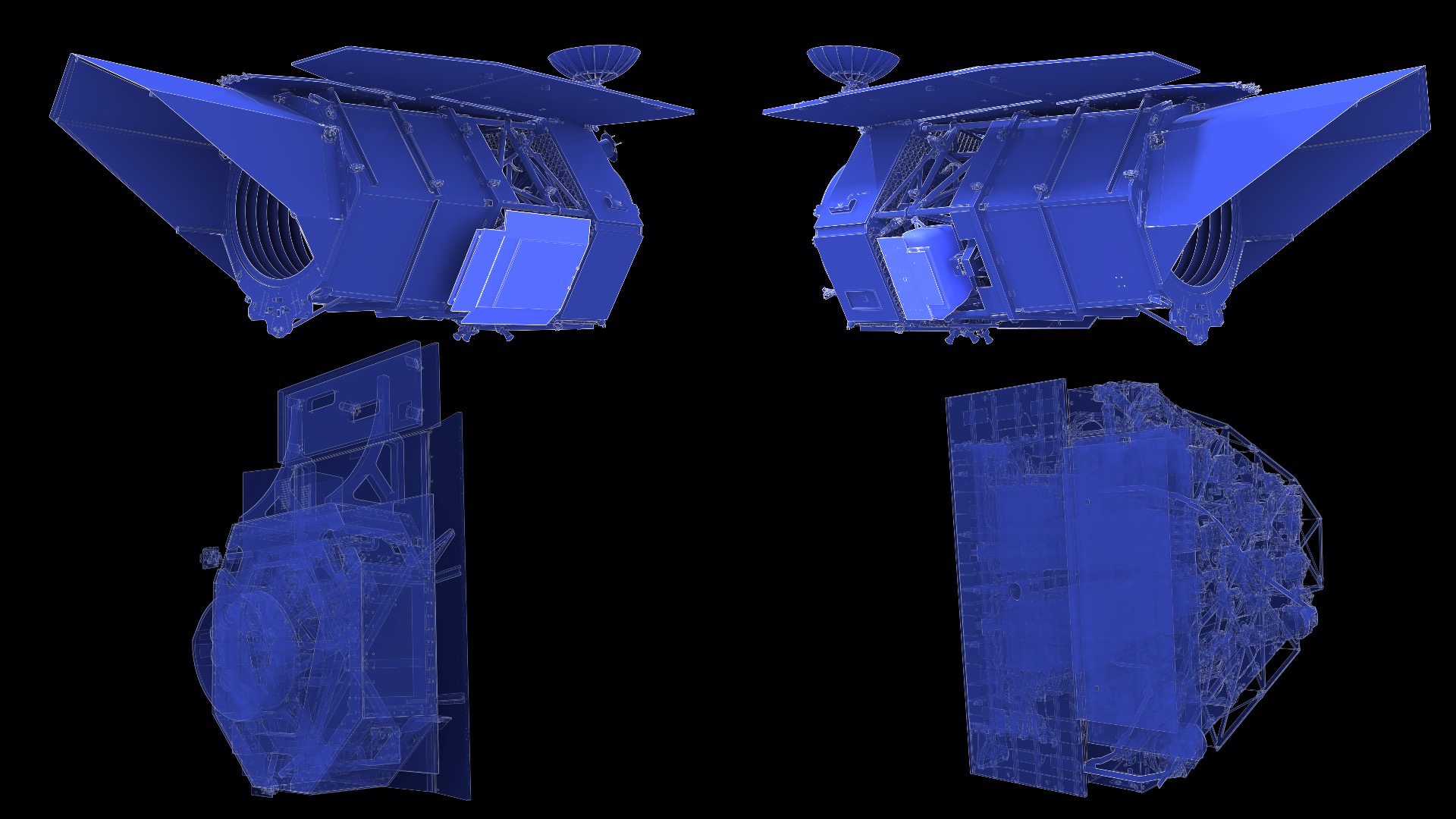
NASA graphic of Roman's Wide Field Instrument and Coronagraph, from NASA's September 15 update. Credit: NASA
Its deformable mirrors have more than 1,600 actuators each, and NASA says each actuator is commanded with a precision better than 62 picometers, less than the diameter of a helium atom. [14] NASA says this technology is used on modern ground-based telescopes but had never been part of a space-based coronagraph. [14] The first observations in September were, in NASA's words, a very limited test. [4]
Measuring Mission Success
NASA says Roman will help settle essential questions in dark energy, exoplanets and astrophysics, and will complete a statistical census of planetary systems in our galaxy. [15] A census does not tell you about any one planet. It tells you what is typical, and what is rare. NASA also says Roman could potentially measure light from a billion galaxies. [15]
To be honest, there is a long list of details the sources I read do not mention: how many stars the bulge survey will monitor, an official count of supernovae, a single success threshold beyond the 326 requirement quoted in a simulation paper (whose exact definition I could not confirm), whether Roman has reached L2, and when its surveys will start. Some of those answers may come once the telescope begins operating.
If Roman works as designed, its most interesting result may not be one dramatic picture. It may be a very large, repeatedly observed map of the sky, detailed enough to test why the universe's expansion is speeding up and to show how common other worlds are.
References
NASA Science. "Roman Launch". Sep 8, 2026. https://science.nasa.gov/mission/roman-space-telescope/roman-launch/
NASA. "NASA's Dark Universe-Seeking Nancy Grace Roman Space Telescope Launches" (news release). Aug 30, 2026. https://www.nasa.gov/news-release/nasas-dark-universe-seeking-nancy-grace-roman-space-telescope-launches/
NASA Science (Roman blog). "NASA Activates Roman's Primary Instrument, Checks Out Coronagraph". Sep 15, 2026. https://science.nasa.gov/blogs/roman/2026/09/15/nasa-activates-romans-primary-instrument-checks-out-coronagraph/
NASA Science (Roman blog). "NASA Checks Roman Guidance System, Takes First Coronagraph Observation". Sep 30, 2026. https://science.nasa.gov/blogs/roman/2026/09/30/nasa-checks-roman-guidance-system-takes-first-coronagraph-observation/
NASA Science. "Frequently Asked Questions" (Roman Space Telescope). Updated Sep 22, 2026. https://science.nasa.gov/mission/roman-space-telescope/frequently-asked-questions/
NASA Science. "High-Latitude Wide-Area Survey - Technical Details". Updated May 26, 2026. https://science.nasa.gov/mission/roman-space-telescope/high-latitude-wide-area-survey-technical/
NASA Goddard. "High-Latitude Wide-Area Survey". https://roman.gsfc.nasa.gov/science/High_Latitude_Wide_Area_Survey.html
NASA Goddard. "High-Latitude Time-Domain Survey". https://roman.gsfc.nasa.gov/science/High_Latitude_Time_Domain_Survey.html
STScI Roman User Documentation. "High-Latitude Time-Domain Survey". Updated Aug 24, 2026. https://roman-docs.stsci.edu/roman-community-defined-surveys/high-latitude-time-domain-survey
Kessler, R. et al. "Cosmology Constraints from Type Ia Supernova Simulations of the Nancy Grace Roman Space Telescope Strategy Recommended by the High Latitude Time Domain Survey Definition Committee". arXiv:2506.04402 (accepted to The Astrophysical Journal). https://arxiv.org/abs/2506.04402
NASA Goddard. "Galactic Bulge Time-Domain Survey". https://roman.gsfc.nasa.gov/science/Galactic_Bulge_Time_Domain_Survey.html
NASA Science. "Microlensing" (Roman Space Telescope). Jul 21, 2026. https://science.nasa.gov/mission/roman-space-telescope/microlensing/
STScI Roman User Documentation. "Galactic Bulge Time-Domain Survey". Updated Aug 24, 2026. https://roman-docs.stsci.edu/roman-community-defined-surveys/galactic-bulge-time-domain-survey
NASA Science. "Roman Coronagraph Systems". Updated Aug 17, 2026. https://science.nasa.gov/mission/roman-space-telescope/coronagraph-systems/
NASA Science. "Nancy Grace Roman Space Telescope" (mission page). Updated Oct 2, 2026. https://science.nasa.gov/mission/roman-space-telescope/
More signals

Project Silica: The Next Generation Information Storage

Discussion